Wedding invitation wording feels like it should be simple until you sit down to write it, and then every sentence starts sounding either too stiff or too casual. The wording does real work beyond conveying the date and venue. It tells guests how formal to dress, who is hosting, and what kind of day to expect before they have read anything else about the wedding. Here is how to get it right, with real, adaptable wording for whatever your family situation actually looks like, whether that's a simple formal template or a blended family that doesn't fit one neatly.

Decide who is hosting first
Traditionally, wording opens with whoever is hosting, meaning whoever is paying for or organising the wedding. That convention has loosened considerably, and today most South African invitations are worded around who feels right for the family, not strict etiquette rules. The three most common structures are the couple hosting themselves, both sets of parents hosting jointly, and one set of parents hosting. None is more correct than another. Pick whichever reflects your actual situation.
The couple hosting themselves
This is now the most common format, especially for couples marrying a little later or covering the costs themselves.
Together with their families,
[Bride's full name]
and
[Groom's full name]
request the pleasure of your company
at their marriage
on [day], the [date] of [month], [year]
at [time]
[venue name]
[venue address]
Both sets of parents hosting
[Parent names]
and
[Parent names]
request the honour of your presence
at the marriage of their children
[Bride's full name]
and
[Groom's full name]
on [day], the [date] of [month], [year]
at [time]
[venue name]
[venue address]
One set of parents hosting
[Parent names]
request the honour of your presence
at the marriage of their daughter
[Bride's full name]
to
[Groom's full name]
son of [Groom's parents' names]
on [day], the [date] of [month], [year]
at [time]
[venue name]
[venue address]
Note the small but real distinction in traditional wording: "request the honour of your presence" is typically used for a religious ceremony, while "request the pleasure of your company" is used for a civil ceremony or reception. It is a minor detail, but it is the kind of thing an older relative may notice, so worth getting right if you are going the formal route.
Wording for divorced or blended families
This is where a lot of couples get stuck, because there is no single template that covers every family shape, and the "correct" etiquette answer often feels colder than what actually fits a modern blended family. A few working approaches:
If both sets of parents are divorced and all four are hosting jointly:
[Mother's name] and [her partner, if included]
and
[Father's name] and [his partner, if included]
together with
[Mother's name] and [her partner, if included]
and
[Father's name] and [his partner, if included]
request the honour of your presence
at the marriage of their children
[Bride's name] and [Groom's name]
If a stepparent has been a significant part of raising the bride or groom and you want to acknowledge that without it reading as a technical legal document, simply listing them alongside the biological parent, in the order that feels right to your family, is entirely acceptable. There is no obligation to follow a strict hierarchy.
A simpler, modern alternative that sidesteps the whole question of parental hosting order: word the invitation around the couple themselves, and thank everyone who helped make the day possible verbally or in a separate note, rather than trying to capture every family relationship in the formal wording itself. This is often the easiest option for genuinely complicated family situations.
Formal versus informal tone
Formal wording spells out numbers and times in full ("the fourteenth of May, two thousand and twenty-seven" rather than "14 May 2027"), avoids abbreviations, and uses phrases like "request the honour of your presence." It suits a black-tie, religious, or traditionally-styled wedding.
Informal wording uses numerals, first names only, and a more conversational structure. It suits a relaxed outdoor wedding, a second marriage, or simply a couple whose personality does not match the formal register. An example:
We're getting married!
Join [Names] and [Names]
on [date] at [time]
[venue]
Dinner and dancing to follow
Neither register is more correct. The right choice is whichever one matches the actual tone of the day you are planning, since a stiff formal invitation for a barefoot beach wedding, or an overly casual one for a black-tie ballroom event, sets the wrong expectation before guests even arrive.
Practical details to include
- Dress code. If you have one, state it clearly (formal, cocktail, smart casual, black tie) rather than leaving guests to guess.
- RSVP details and deadline. Give a clear date, at least three to four weeks before the wedding, and a method (a card to return, a wedding website, or a direct number).
- Whether children are invited. This is one of the most commonly mishandled details. Address the envelope to only the guests invited if children are excluded, and if needed, add a gentle line such as "we have planned an adults-only celebration" rather than leaving it ambiguous.
- Dietary requirements. A short line asking guests to note any dietary requirements on the RSVP saves a lot of last-minute back and forth with your caterer.
- Registry or gift information. Etiquette still generally advises against printing registry details directly on the invitation itself. Put this on a wedding website or a separate insert card instead.
Save-the-date wording
Save-the-dates are shorter and less formal than the invitation itself, since the full details follow later. A simple, working structure:
Save the date
[Names] are getting married
[date]
[city or venue]
Formal invitation to follow
Send save-the-dates six to eight months ahead for a local wedding, and up to a year ahead if you are planning a destination wedding or expect a significant number of guests to travel.
If you have eloped or married privately
Couples who marry privately and then invite guests to celebrate afterward need slightly different wording, since the invitation is to a celebration rather than the ceremony itself.
We're married!
Join us to celebrate
[Names] and [Names]
at a reception on [date] at [time]
[venue]
This format works equally well for a small private ceremony followed by a larger party, or for couples who eloped entirely and want to celebrate with family and friends once they are home.
Engagement party wording
Engagement invitations follow a similar structure to wedding invitations but are naturally shorter, since there is less logistical detail to communicate.
Please join us to celebrate
the engagement of
[Names] and [Names]
on [date] at [time]
[venue]
Outer and inner envelope etiquette, if you're going formal
For a traditionally formal invitation suite, the outer envelope carries the guest's full name and postal address, written out in full (no abbreviations like "St" for "Street"). The inner envelope, if you're using one, carries a less formal version, typically just titles and surnames ("Mr and Mrs Adams" or "Lindiwe and family"), and signals exactly who is invited. This is especially useful for indicating whether children or a plus-one are included without needing a separate line on the invitation itself. Most modern South African weddings skip the inner envelope entirely and rely on a single envelope plus a clear RSVP card instead, which is simpler and equally clear as long as the "who's invited" question is addressed somewhere.
Multi-language and cultural wording
For weddings blending English with Afrikaans, isiZulu, isiXhosa, or another home language, it's increasingly common to print the invitation bilingually rather than choosing one language over the other, particularly when the two families come from different linguistic backgrounds. A short, warm line in the second language, even if the bulk of the wording is in English, goes a long way for older relatives who are more comfortable reading in their home language. For traditional ceremonies such as umembeso, lobola celebrations, or a nikah, it's worth including a brief explanatory line for guests unfamiliar with the customs, especially if dress code or gift expectations differ from what a Western-style wedding guest might assume.
A few wording mistakes worth avoiding
- Mixing formal and informal registers in the same invitation. Spelling out "two thousand and twenty-seven" next to "RSVP asap" reads as inconsistent. Pick one tone and stay with it throughout.
- Leaving the hosting line ambiguous when parents have contributed unevenly. If it matters to your family who is named, have the conversation before the wording is finalised, not after the invitations are printed.
- Forgetting a clear RSVP deadline. Without one, replies trickle in for weeks, which makes final catering numbers genuinely difficult to confirm.
- Assuming guests will infer the dress code or child policy. State both directly rather than leaving room for guesswork.
Once your wording is settled, our guide to when to send your wedding invitations covers the timing side of the process. And if you are still finalising the guest list itself, our wedding planning checklist is a useful next stop for keeping the rest of the admin on track.

You're Invited: Unique Wedding Invitation Ideas
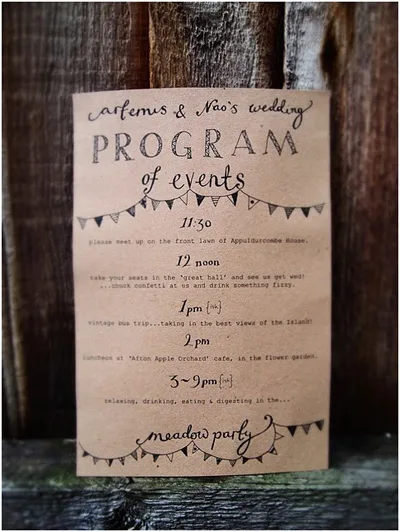
The Wedding Program

Afrikaanse Trou-uitnodigings: Bewoording, Etiket en Voorbeelde

Toesprake by 'n Troue: Wie Praat, Wanneer, en Wat om te Verwag

How Much Does a Wedding Planner Cost in South Africa? (2026 Guide)