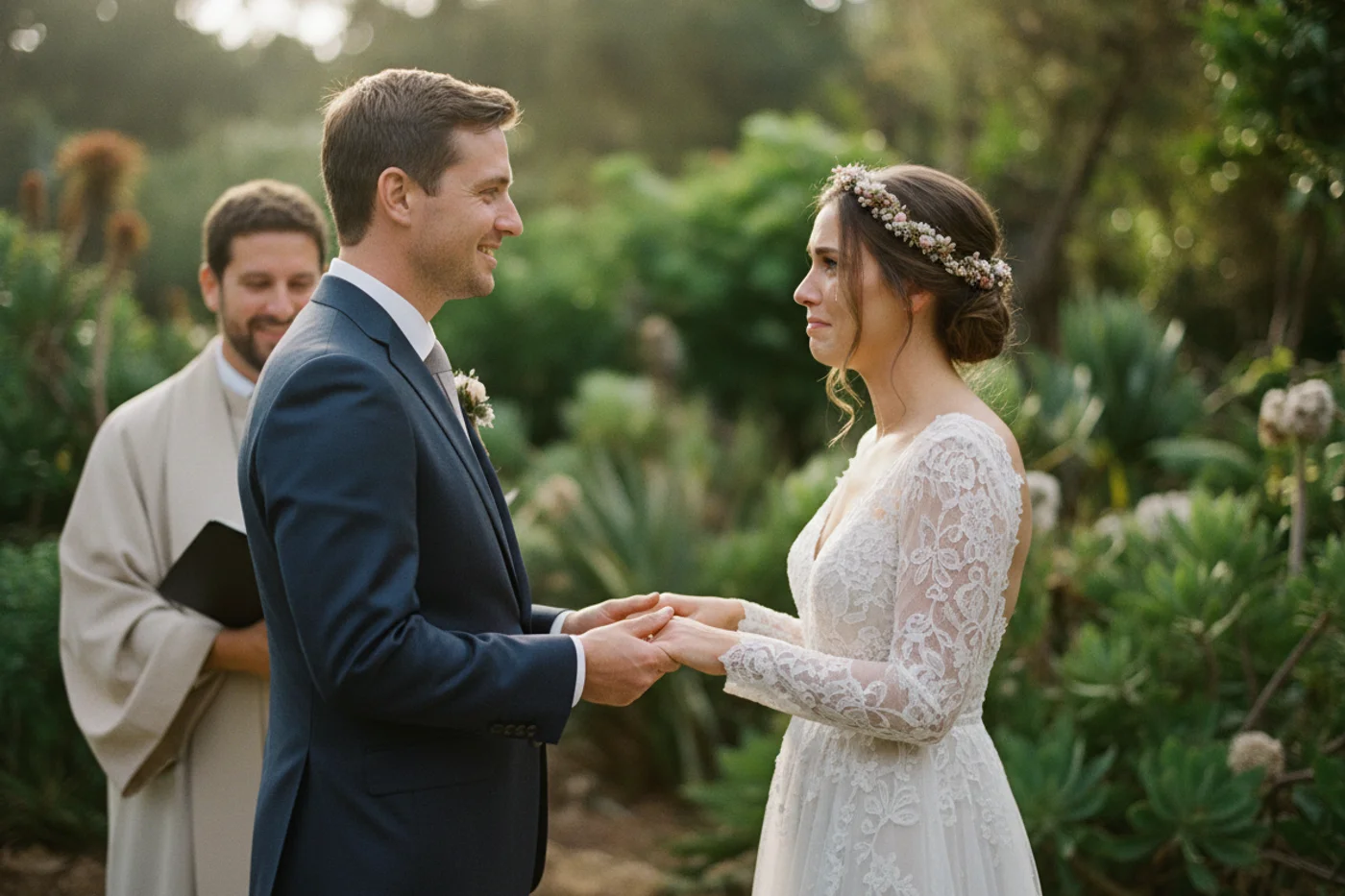
Not every ceremony has room, or need, for a five-minute reading. If your programme is already full, if you want something a friend without much public speaking experience can deliver comfortably, or if you simply prefer a shorter, more concentrated moment of reflection, these four pieces are built for exactly that. Each one is short enough to read in under ninety seconds, and each has been used at countless weddings for good reason: they say a great deal in very few words.
If you'd like something longer or more literary in style, our other collections cover classic English poetry, Shakespeare's sonnets, modern and unconventional 20th-century verse, and the most famous, widely quoted love poems in the language. Here, brevity is the whole point.
The Apache Wedding Blessing
Now you will feel no rain, for each of you will be shelter to the other. Now you will feel no cold, for each of you will be warmth to the other. Now there is no more loneliness for you. Now you are two persons, but there is only one life before you. Go now to your dwelling place, to enter into the days of your life together. And may your days be good and long upon the earth.
This blessing, commonly known as the Apache Wedding Blessing, has become one of the most widely used wedding readings in the English-speaking world, its imagery of mutual shelter and shared warmth capturing exactly what marriage is meant to offer two people. Its actual origins are debated among scholars, with some tracing its popular English form to a 20th-century writer rather than a verified Indigenous source, but its message of partnership and protection has resonated deeply enough to remain a wedding staple for generations, regardless of ceremony type, whether spiritual, secular, or somewhere in between.
A Traditional Irish Blessing
May the road rise up to meet you. May the wind be always at your back. May the sun shine warm upon your face, and rain fall soft upon your fields. And until we meet again, may love and laughter light your days, and warm and peaceful be your nights.
This is an adapted wedding version of one of the most famous traditional Irish blessings, originally a general blessing of good fortune and protection, gently reworked here to suit a married couple beginning their life together. Its gentle, rolling rhythm makes it genuinely easy to read aloud, even for a nervous first-time speaker, and its warm, unfussy sentiment suits almost any wedding style, from a formal church ceremony to a relaxed outdoor celebration. If either partner has Irish heritage, it carries an obvious extra layer of meaning, but it reads beautifully regardless of background.
On Marriage (an excerpt)
Let there be spaces in your togetherness, And let the winds of the heavens dance between you.
Love one another, but make not a bond of love: Let it rather be a moving sea between the shores of your souls.
Fill each other's cup but drink not from one cup. Give one another of your bread but eat not from the same loaf.
Sing and dance together and be joyous, but let each one of you be alone, Even as the strings of a lute are alone though they quiver with the same music.
Give your hearts, but not into each other's keeping. For only the hand of Life can contain your hearts.
And stand together yet not too near together: For the pillars of the temple stand apart, And the oak tree and the cypress grow not in each other's shadow.
Kahlil Gibran (1883-1931), Lebanese-American poet and writer, published this passage as part of "On Marriage" in his 1923 book The Prophet, one of the best-selling and most widely translated works of the 20th century. Rather than a conventional declaration of love, it argues for a marriage built on healthy independence, two people growing together while still remaining fully themselves. It's an excellent choice for a couple who value individuality within their partnership, and who want their ceremony to say something wiser and more nuanced than a simple promise of togetherness.
The Blessing of the Hands
These are the hands of your best friend, young and strong and full of love for you, that are holding yours on your wedding day, as you promise to love each other today, tomorrow, and forever.
These are the hands that will work alongside yours, as together you build your future.
These are the hands that will passionately love you and cherish you through the years, and with the slightest touch, will comfort you like no other.
These are the hands that will hold you when fear or grief fills your mind.
These are the hands that will countless times wipe the tears from your eyes, tears of sorrow, and tears of joy.
These are the hands that will tenderly hold your children.
These are the hands that will help you hold your family as one.
And lastly, these are the hands that, even when wrinkled and aged, will still be reaching for yours, still giving you the same unspoken tenderness with just a touch.
This reading, of unknown authorship but widely used at weddings for decades, has become a favourite specifically for the ring exchange or a hand-fasting moment, since it draws attention literally to the hands doing the exchanging. Many couples ask their officiant to read it while they're physically holding hands, just before or during the placing of the rings, which grounds the words in something guests can actually see happening in real time.
Where Short Readings Work Best
These four pieces suit a handful of specific moments particularly well. At the ring exchange, a short reading gives the moment ceremonial weight without slowing the pace of the service. As an opening reading, before the vows themselves, a short blessing sets a warm, reflective tone without asking guests to sit through several minutes of poetry before the ceremony's main event. And for programmes already packed with multiple elements, unity rituals, cultural customs, several family readings, a short piece lets you include a literary or spiritual moment without derailing the overall timing of the day.
Who Should Deliver a Short Reading
Because these pieces are brief, they're a good option for a reader who's nervous about public speaking but still wants to be included meaningfully in the ceremony, a young cousin, an older relative who doesn't often speak in public, or a friend who'd rather not commit to memorising or rehearsing several minutes of material. A short reading still carries genuine weight and meaning, and asking someone to deliver one is a lovely way to give them a role in the day that matches their comfort level.
Combining Short Readings With a Longer One
There's no rule limiting you to a single reading, and many couples pair one of these shorter, more universal pieces with a longer, more personal poem elsewhere in the ceremony. A short traditional blessing works well early on to settle the room, while a longer, more personal poem later, perhaps one that specifically reflects your relationship, can serve as the more intimate, individual moment. Used together thoughtfully, rather than simply stacked back to back, they can give a ceremony real range: a sense of timeless, shared tradition alongside something unmistakably your own.
Printing Short Readings in Your Programme
Because these pieces are brief, they cost very little space in a printed programme, and including the full text alongside the ceremony order of events is a nice touch for guests who want to follow along or revisit it afterwards. If you're using a piece of unknown or disputed authorship, like the Apache Wedding Blessing or the Blessing of the Hands, it's honest and good practice to credit it simply as "traditional" or "author unknown" rather than attributing it to a specific person, since neither piece has a firmly documented single author despite wide circulation over many decades.
A Note on Timing Your Ceremony
One of the quiet advantages of a short reading is how much easier it makes rehearsal and timing on the day itself. A five-minute poem read by a nervous first-time speaker can easily stretch to seven or eight minutes once nerves slow the pace down, throwing off a tightly scheduled ceremony that needs to end by a certain time for photography or a reception changeover. A short reading has much less room to run long, which gives your MC or wedding coordinator one less variable to manage on a day that already has plenty of moving parts. If your ceremony has a firm end time, whether due to venue restrictions, a second event at the same location, or simply a desire to keep things moving, leaning toward shorter readings throughout the programme is a small, practical choice that pays off on the day.
Ask whoever is reading to time themselves during a rehearsal, reading at the pace they genuinely expect to use on the day rather than rushing through it as a formality, so you have an accurate sense of how long the ceremony will actually run rather than an optimistic guess.
Shakespeare Wedding Readings Part IV: Words for Steadfast Love
Romantic Poems Part III: Short Poems for Wedding Readings
Romantic Poems Part VII

Umembeso: The Zulu Gift-Giving Ceremony Explained

The Modern Marriage Officer