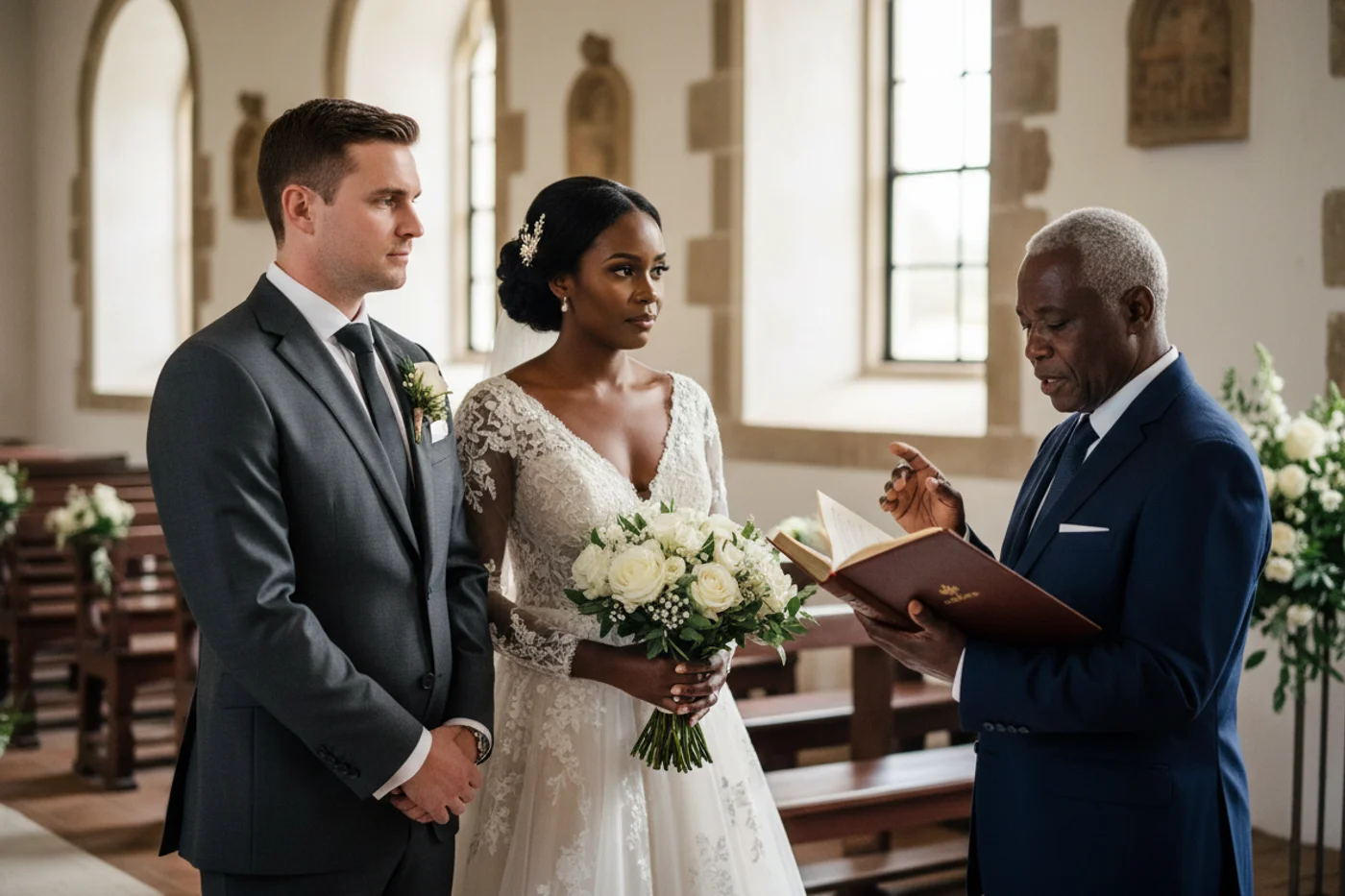
No English writer has been quoted at more weddings than William Shakespeare (1564-1616), and for good reason. His sonnets manage something difficult: language elevated enough to feel ceremonial, built four centuries ago, that still describes love in terms modern couples immediately recognise as true. If you want your ceremony reading to carry genuine literary weight, and you'd rather stick with one voice across the whole collection than mix several poets, this is the collection for you.
This selection focuses purely on Shakespeare's 154 sonnets, five of the strongest choices for a wedding reading, ranging from the famous and reverent to the wry and unexpectedly funny. If you'd prefer a broader mix of poets and eras, our other reading collections cover classic English poetry, 20th-century and unconventional verse, and short contemporary readings for a tighter programme.
Sonnet 105: Let Not My Love Be Called Idolatry
Let not my love be called idolatry, Nor my beloved as an idol show, Since all alike my songs and praises be To one, of one, still such, and ever so. Kind is my love to-day, to-morrow kind, Still constant in a wondrous excellence; Therefore my verse to constancy confined, One thing expressing, leaves out difference. Fair, kind, and true, is all my argument, Fair, kind, and true, varying to other words; And in this change is my invention spent, Three themes in one, which wondrous scope affords. Fair, kind, and true, have often lived alone, Which three till now, never kept seat in one.
The poet insists his devotion isn't excessive worship but simple, sustained constancy: the same praise, said differently, addressed to the same person, day after day. That repetition is the point. It's a lovely choice for a couple who want their reading to say something about steadiness rather than swept-off-your-feet drama, the kind of love that shows up the same way every single day rather than only in grand gestures.
Sonnet 109: O, Never Say That I Was False of Heart
O, never say that I was false of heart, Though absence seemed my flame to qualify. As easy might I from my self depart As from my soul which in thy breast doth lie. That is my home of love; if I have ranged, Like him that travels I return again, Just to the time, not with the time exchanged, So that myself bring water for my stain. Never believe though in my nature reigned All frailties that besiege all kinds of blood, That it could so preposterously be stained To leave for nothing all thy sum of good; For nothing this wide universe I call Save thou, my rose, in it thou art my all
Using travel as its central metaphor, this sonnet reassures a partner that time apart never dimmed the poet's love, and that wherever he wandered, he always found his way back. It's a genuinely lovely choice for couples who've weathered long-distance stretches in their relationship, whether through work, study or simply circumstance, since it directly addresses the fear that distance changes how someone feels, and answers it with total certainty.
Sonnet 116: Let Me Not to the Marriage of True Minds
Let me not to the marriage of true minds Admit impediments; love is not love Which alters when it alteration finds, Or bends with the remover to remove: O, no, it is an ever-fixed mark, That looks on tempests and is never shaken; It is the star to every wand'ring bark, Whose worth's unknown, although his heighth be taken. Love's not Time's fool, though rosy lips and cheeks Within his bending sickle's compass come; Love alters not with his brief hours and weeks, But bears it out even to the edge of doom. If this be error and upon me proved, I never writ, nor no man ever loved.
Arguably Shakespeare's most well known and best-loved sonnet, and the one most directly tied to marriage itself, both in its opening line and its central theme. Its subject is love in its most ideal, unconditional form. In the famous line "love is not love which alters when it alteration finds," Shakespeare argues that real love isn't judgemental or contingent on circumstance; it's constant and unwavering regardless of what changes around it. If you only read one Shakespeare sonnet at your wedding, this is almost certainly the one most guests will recognise, and it works as well at a large formal wedding as it does at a small, intimate one.
Sonnet 130: My Mistress' Eyes Are Nothing Like the Sun
My mistress' eyes are nothing like the sun; Coral is far more red than her lips' red; If snow be white, why then her breasts are dun; If hairs be wires, black wires grow on her head. I have seen roses damasked, red and white, But no such roses see I in her cheeks; And in some perfumes is there more delight Than in the breath that from my mistress reeks. I love to hear her speak, yet well I know That music hath a far more pleasing sound; I grant I never saw a goddess go; My mistress, when she walks, treads on the ground. And yet, by heaven, I think my love as rare As any she belied with false compare.
Written with a healthy dash of irony and Shakespeare's characteristic wry humour, this sonnet plays against every expectation of romantic poetry. Poets are supposed to idealise their beloved with grand comparisons to the sun, roses and goddesses; here, Shakespeare deliberately does the opposite, cataloguing every way his mistress fails to match those comparisons, only to conclude that his love for her is just as rare and real regardless. It's a genuinely funny, refreshingly honest choice for a couple who don't want their ceremony to feel overly solemn, and it tends to get a warm laugh from guests followed by an even warmer response to the closing couplet.
Sonnet 141: In Faith I Do Not Love Thee With Mine Eyes
In faith I do not love thee with mine eyes, For they in thee a thousand errors note; But 'tis my heart that loves what they despise, Who, in despite of view, is pleased to dote. Nor are mine ears with thy tongue's tune delighted; Nor tender feeling, to base touches prone, Nor taste, nor smell, desire to be invited To any sensual feast with thee alone: But my five wits nor my five senses can Dissuade one foolish heart from serving thee, Who leaves unsway'd the likeness of a man, Thy proud heart's slave and vassal wretch to be: Only my plague thus far I count my gain, That she that makes me sin awards me pain.
Here the poet admits that his senses find fault with his beloved on every count, and none of it matters, his heart carries on regardless, entirely unmoved by the objections his eyes, ears and other senses keep raising. It's an unusually candid acknowledgment that love doesn't always operate on logic, and it suits a couple who appreciate a bit of self-deprecating honesty in their reading rather than pure, unqualified reverence.
Choosing the Right Sonnet for Your Ceremony
Sonnet 116 remains the safest, most universally recognised choice if you want a reading that unmistakably signals marriage and commitment to a room full of guests. Sonnet 105 suits a quieter, steadier tone. Sonnet 109 works beautifully for a couple who weathered real distance during their relationship. And Sonnets 130 and 141 are excellent choices for couples who want a moment of genuine warmth and humour woven into an otherwise formal ceremony, without sacrificing literary credibility.
Reading Shakespeare Aloud Without It Sounding Stiff
Shakespeare's language can trip up even confident readers if they don't prepare properly, so treat the reading like a small performance rather than something to glance at for the first time at the lectern. Whoever reads it should look up the meaning of any unfamiliar words or phrasing beforehand, since understanding what a line actually means changes how naturally it comes out spoken aloud. Practising with the emphasis on meaning, rather than simply getting through the unusual word order, makes an enormous difference to how the sonnet lands with an audience.
It also helps to remember that a sonnet is built in three quatrains and a closing couplet, and that final couplet almost always delivers the poem's real point. Slow down noticeably for those last two lines rather than rushing through them at the same pace as the rest, since that's where Shakespeare typically lands his argument, and where the room should feel it most.
Pairing a Sonnet With the Rest of Your Ceremony
A Shakespeare sonnet reads beautifully as a standalone reading between the opening remarks and the vows, giving guests a quiet, literary moment before the ceremony's emotional centre. It also works well printed in full inside your programme, so guests who want to sit with the language a little longer, rather than catching it once, spoken, can revisit it afterwards. If your ceremony includes readings from more than one source, whether a second poem, a religious text, or a personal letter, place the Shakespeare sonnet either first or last in that sequence rather than in the middle, since its distinct, elevated language tends to land best when it isn't sandwiched between two very different tones.
A Note on Attribution and Programmes
Because Shakespeare's sonnets are numbered rather than titled in the way most poems are, it's worth printing both the sonnet number and its familiar first line in your programme, for example "Sonnet 116: Let Me Not to the Marriage of True Minds," so guests unfamiliar with the numbering system can still follow along and look it up again later if it moved them. As with all of Shakespeare's work, it sits fully in the public domain, so there's no permission needed to use it; a small printed credit is simply good literary manners rather than a legal requirement.

Shakespeare Poems Part III: Wedding Sonnets Beyond the Greatest Hits

The Most Famous Love Poems for Your Wedding
Romantic Poems Part IV: Readings to Say Aloud at Your Wedding

Romantic Quotes Part II

All You Need to Know About Wedding Favours