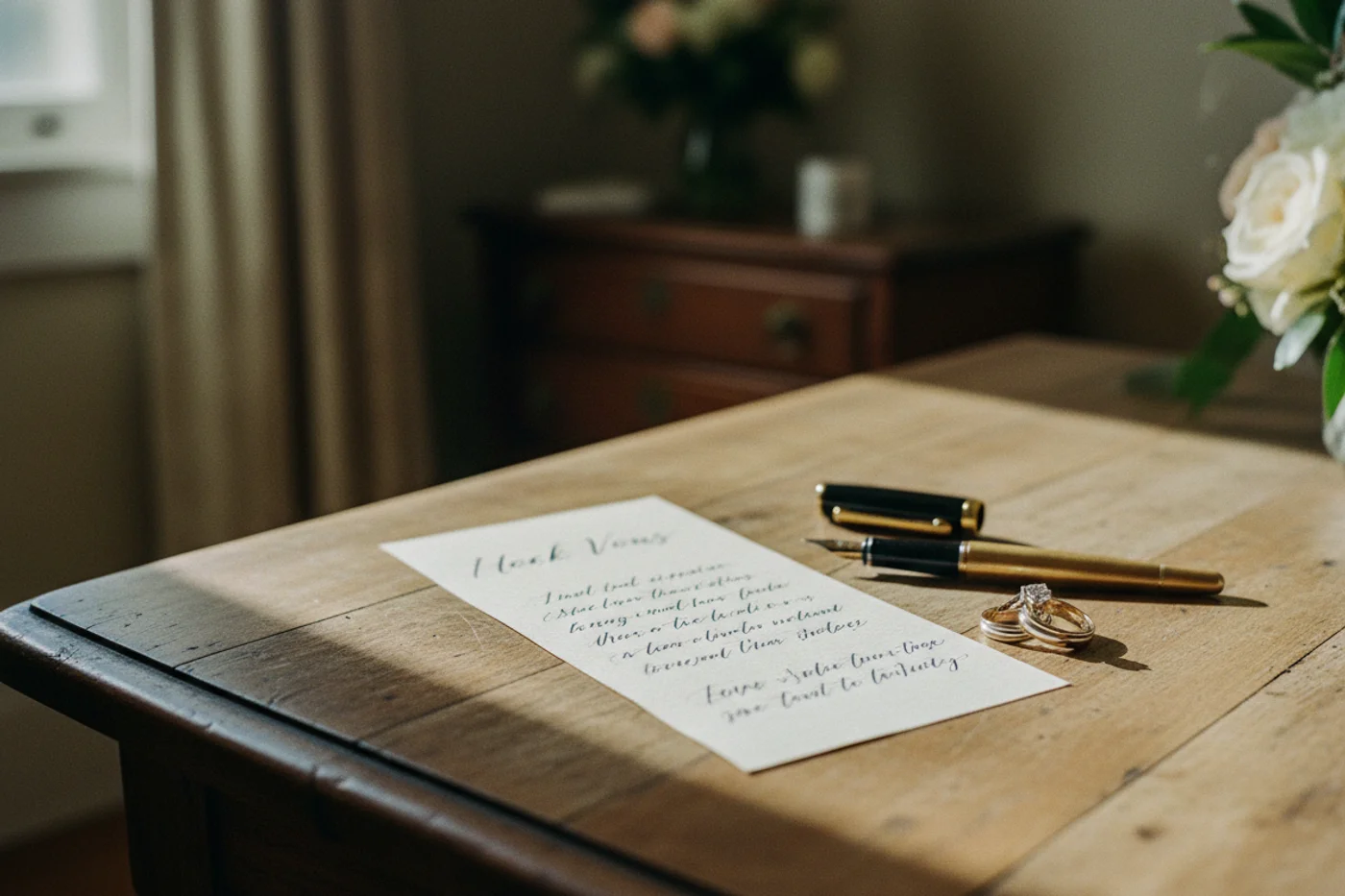
Most couples reach for the same two or three Shakespeare sonnets when they're looking for a ceremony reading, usually Sonnet 116 with its "marriage of true minds," or Sonnet 18's "shall I compare thee to a summer's day." They're beautiful, and there's a reason they're used so often. But Shakespeare wrote 154 sonnets, and some of his sharpest, funniest and most emotionally honest writing about love lives in the ones nobody quotes at weddings. This collection is for couples who want something with a bit more wit, a bit more grit, or a bit more history behind it than the greatest hits.
Sonnet 130: My Mistress' Eyes Are Nothing Like the Sun
My mistress' eyes are nothing like the sun;
Coral is far more red than her lips' red;
If snow be white, why then her breasts are dun;
If hairs be wires, black wires grow on her head.
I have seen roses damasked, red and white,
But no such roses see I in her cheeks;
And in some perfumes is there more delight
Than in the breath that from my mistress reeks.
I love to hear her speak, yet well I know
That music hath a far more pleasing sound;
I grant I never saw a goddess go;
My mistress, when she walks, treads on the ground.
And yet, by heaven, I think my love as rare
As any she belied with false compare.
This is Shakespeare having fun at the expense of every overwrought love poem ever written, the kind stuffed with roses, goddesses and suns for eyes. Instead, he describes an entirely ordinary, human woman and concludes, with total sincerity, that his love for her is every bit as rare as any poet's exaggerated devotion to an idealised beauty. For couples who find traditional romantic language a bit much, or who simply love each other's real, unpolished selves rather than some airbrushed version, Sonnet 130 is a genuinely funny, genuinely touching alternative. It also happens to land brilliantly read aloud with the right comic timing, if you have a reader in your wedding party who can deliver a line.
Sonnet 29: When in Disgrace with Fortune and Men's Eyes
When in disgrace with fortune and men's eyes
I all alone beweep my outcast state,
And trouble deaf heaven with my bootless cries,
And look upon myself, and curse my fate,
Wishing me like to one more rich in hope,
Featured like him, like him with friends possessed,
Desiring this man's art, and that man's scope,
With what I most enjoy contented least;
Yet in these thoughts myself almost despising,
Haply I think on thee, and then my state,
Like to the lark at break of day arising
From sullen earth, sings hymns at heaven's gate;
For thy sweet love remembered such wealth brings
That then I scorn to change my state with kings.
This sonnet doesn't open with love at all. It opens with despair, self-pity, and envy of everyone else's life. Only in the final six lines does the turn happen: simply thinking of the person he loves lifts him entirely out of that darkness. It's an honest, unflinching depiction of what it actually feels like to have someone whose presence in your memory alone can change your whole state of mind. For couples who've supported each other through genuinely hard seasons, job losses, grief, self-doubt, this sonnet says something far more specific and earned than most standard wedding readings manage.
Sonnet 25: Let Those Who Are in Favour with Their Stars
Let those who are in favour with their stars
Of public honour and proud titles boast,
Whilst I, whom fortune of such triumph bars,
Unlooked for joy in that I honour most.
Great princes' favourites their fair leaves spread
But as the marigold at the sun's eye,
And in themselves their pride lies buried,
For at a frown they in their glory die.
The painful warrior famousèd for fight,
After a thousand victories once foiled,
Is from the book of honour razèd quite,
And all his worth forgot in the strife.
Then happy I, that love and am beloved
Where I may not remove nor be removed.
Sonnet 25 makes the case that quiet, steady love is worth more than status, fame or public glory, all of which can vanish in an instant, while love that's mutual and secure endures. It's a fitting choice for a couple who built their relationship away from the spotlight, without a grand public courtship or a dramatic proposal story, and who value that steadiness precisely because it doesn't depend on anyone else's approval or attention.
Sonnet 91: Some Glory in Their Birth, Some in Their Skill
Some glory in their birth, some in their skill,
Some in their wealth, some in their body's force,
Some in their garments, though new-fangled ill,
Some in their hawks and hounds, some in their horse;
And every humour hath his adjunct pleasure,
Wherein it finds a joy above the rest;
But these particulars are not my measure:
All these I better in one general best.
Thy love is better than high birth to me,
Richer than wealth, prouder than garments' cost,
Of more delight than hawks and horses be;
And having thee, of all men's pride I boast:
Wretched in this alone, that thou mayst take
All this that pride can take from me.
Shakespeare runs through everything people typically build their identity and pride around, birth, wealth, fashion, hobbies, and declares that one relationship outweighs the lot. The final couplet adds a vulnerable twist: the only thing wretched about this arrangement is how completely his happiness now depends on someone else's choice to stay. It's an honest acknowledgment of the risk inherent in loving someone fully, which makes it a particularly meaningful reading for a second reading later in a ceremony, after vows have already been exchanged and both partners have just formally accepted that risk together.
Why Choose a Lesser-Known Sonnet for Your Ceremony
There's nothing wrong with the famous ones. But a less commonly used sonnet carries a few real advantages. Guests who have sat through dozens of weddings won't have heard it dozens of times before, so it lands with more attention and genuine surprise. A sonnet chosen for a specific, honest reason, because it captures a particular truth about your relationship rather than because it's the default wedding poem, tends to mean more to the couple themselves too. And because these sonnets cover a wider emotional range than the handful usually recycled, sorrow turned to joy, humour, quiet steadiness, vulnerability, you have more room to find one that actually matches your story rather than forcing your story to match a generic poem about eternal, unshaken love.
How to Use a Sonnet in a Modern Ceremony
Shakespearean English can trip up an unrehearsed reader, so if you're asking a friend or family member to deliver one of these, give them the text well in advance and encourage at least two or three practice run-throughs aloud, ideally with someone else listening, before the day itself. Print the sonnet clearly in a large, readable font rather than relying on a phone screen, and consider adding a brief, plain-English introduction before the reading itself, one or two sentences on why you chose this particular sonnet, so guests unfamiliar with the language have context for what they're about to hear.
These sonnets also work well split between two readers, alternating lines or stanzas, which adds a nice sense of dialogue and keeps a solo reader from carrying the full weight and nerves of the performance alone. If you'd rather not include a full sonnet as a stand-alone reading, a single couplet or quatrain lifted from one of these and worked into your own vows or into the officiant's opening remarks is an elegant, lower-pressure way to bring Shakespeare's language into your day without a full formal recitation.
Sonnet 116 Casts a Long Shadow, and That's Fine
It's worth saying plainly: there's no rule against using a well-known sonnet, and if one of the famous ones genuinely speaks to your relationship, use it without a second thought. The point of exploring the lesser-known corners of Shakespeare's sonnets isn't to be contrarian for its own sake. It's that his most anthologised, most Instagrammed lines represent only a narrow slice of what he actually wrote about love, mostly the grand, sweeping, unshakeable kind. Real relationships also involve envy, insecurity, humour at each other's expense, gratitude for ordinary steadiness, and a fair amount of vulnerability. The wider catalogue of sonnets has something honest to say about all of it, and reading further than the first page of any "top wedding poems" list is often rewarded with something that fits your particular relationship far better than the poem everyone expects to hear.
Pairing a Sonnet with Your Own Vows
One approach that works particularly well for couples writing their own vows is to let a sonnet's central idea, rather than its exact wording, inform what you say to each other. If Sonnet 29's turn from despair to gratitude resonates, you might reference a specific hard season your partner helped you through. If Sonnet 130's honest, unromanticised affection appeals, your own vows can lean into specific, real, slightly unglamorous details about your partner rather than sweeping abstractions. Shakespeare's structure, four hundred years old and still remarkably effective, moves from observation to turn to resolution in fourteen lines. Borrowing that shape, even loosely, gives your own words a satisfying arc without requiring you to write like a sixteenth-century poet.
Final Thought
Shakespeare wrote about more kinds of love than the swept-away, star-crossed variety that gets quoted at almost every wedding. He wrote about love that rescues you from despair, love that outlasts fame, love that's funny and unglamorous and entirely real. If the famous sonnets never quite captured what your relationship actually feels like, there's a good chance one of these lesser-known ones will.
Romantic Poems Part III: Short Poems for Wedding Readings
Famous Love Poems Part I: The Essential Classics for Your Ceremony
Romantic Poems Part IV: Readings to Say Aloud at Your Wedding

The Most Famous Love Poems for Your Wedding

Meet Dr Heinrich Lottering: Pretoria's Marriage Officer With a Medical Degree and Two PhDs