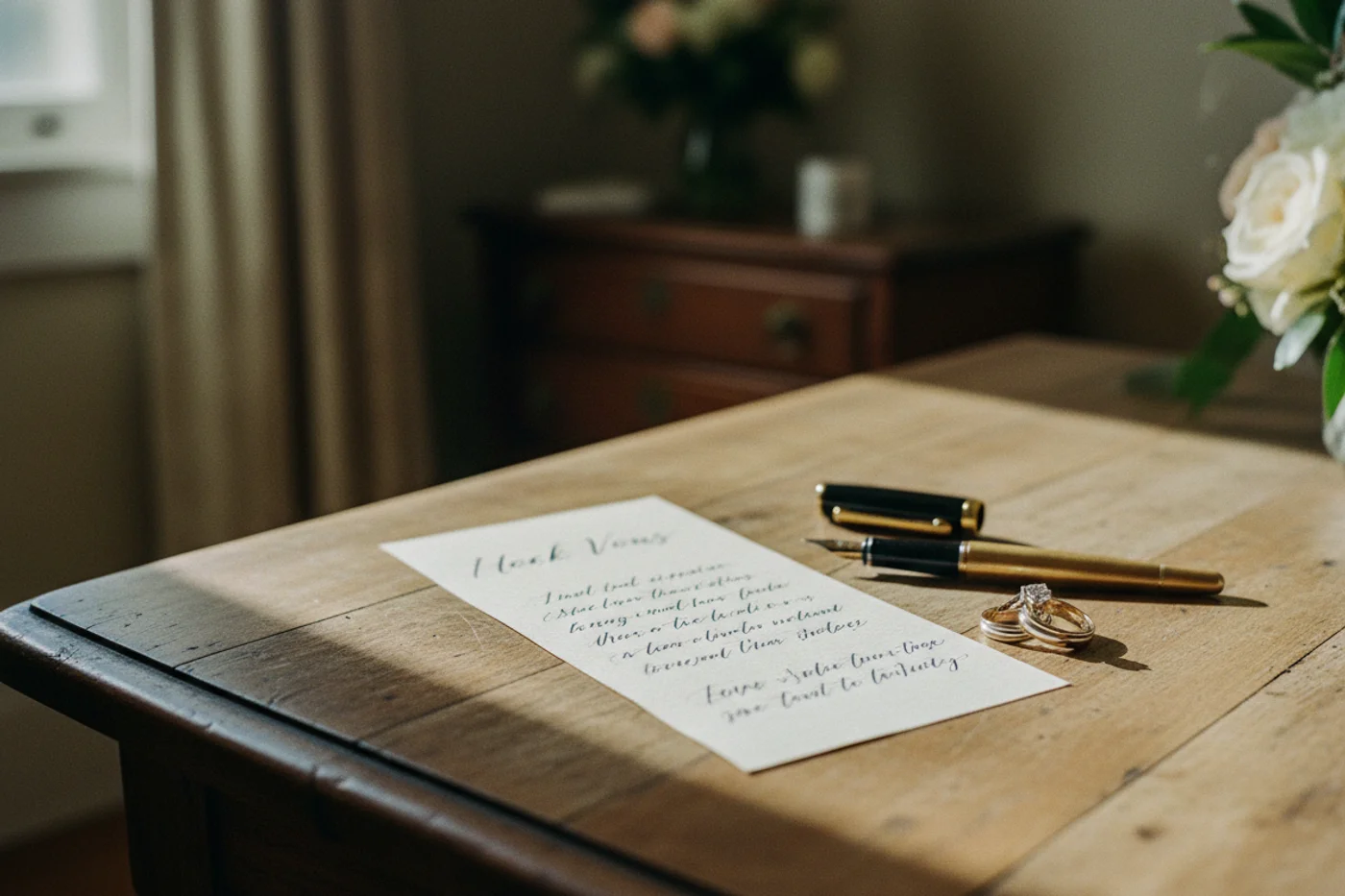
Not every wedding reading needs to run three or four stanzas deep. Some of the most affecting poems ever written about love say what they need to say in eight or twelve lines, and finish before anyone in the room has time to grow restless. This collection is for exactly that: short, complete, genuinely moving poems that take under a minute to read aloud, ideal if you want a reading delivered by a nervous grandparent, a young cousin, or simply want the ceremony to keep moving without a lengthy pause for poetry.
A Red, Red Rose, by Robert Burns
O my Luve's like a red, red rose
That's newly sprung in June;
O my Luve's like the melody
That's sweetly played in tune.
So fair art thou, my bonnie lass,
So deep in luve am I;
And I will luve thee still, my dear,
Till a' the seas gang dry.
Till a' the seas gang dry, my dear,
And the rocks melt wi' the sun;
I will love thee still, my dear,
While the sands o' life shall run.
Written in 1794, this remains one of the most quoted love poems in the English language, and it earns that status with remarkable economy. In twelve lines, Burns compares his love to a rose and a melody, then declares its permanence through images of impossibility, drying seas, melting rocks, that have lost none of their power in over two centuries. The light Scots dialect ("luve," "gang dry") gives it a warmth and specificity that a purely modern-English version wouldn't carry, and it reads beautifully whether spoken with a light accent or in a neutral voice.
I Am Not Yours, by Sara Teasdale
I am not yours, not lost in you,
Not lost, although I long to be
Lost as a candle lit at noon,
Lost as a snowflake in the sea.
You love me, and I find you still
A spirit beautiful and bright,
Yet I am I, who long to be
Lost as a light is lost in light.
Oh plunge me deep in love, put out
My senses, leave me deaf and blind,
Swept by the tempest of your love,
A taper in a rushing wind.
Sara Teasdale, writing in 1915, captures a specific, honest kind of longing rarely voiced this directly in wedding poetry: the desire to be completely consumed by love, while acknowledging that she isn't yet, or not fully. It's a poem about wanting rather than already having, which makes it a striking, less conventional choice for a wedding reading, more expression of longing that the marriage itself is meant to answer than a poem about arrival. For a couple who appreciate a bit of romantic intensity and yearning alongside the joy of the day, this is a genuinely different register from the usual "we've found each other, happily ever after" reading.
Sudden Light, by Dante Gabriel Rossetti
I have been here before,
But when or how I cannot tell:
I know the grass beyond the door,
The sweet keen smell,
The sighing sound, the lights around the shore.
You have been mine before,—
How long ago I may not know:
But just when at that swallow's soar
Your neck turned so,
Some veil did fall,—I knew it all of yore.
This short, dreamlike poem from 1854 touches on the idea of a love that feels older and deeper than the relationship's actual timeline, as though recognising someone rather than simply meeting them. It suits a couple who describe their own relationship in similar terms, a sense of instant, inexplicable familiarity, and its brevity and gentle, slightly mysterious tone make it a lovely, understated choice for a reading that doesn't need to be loud or declarative to land emotionally.
That I Did Always Love, by Emily Dickinson
That I did always love
I bring thee proof:
That till I loved
I did not love enough.
That I shall love always,
I offer thee
That love is life,
And life hath immortality.
This, dear, I doubt not, but I never spoke,
And, had I not
Been made perfect by love,
I could not have proved it.
Dickinson rarely wrote anything long, and this poem is a perfect example of how much emotional and philosophical weight she could compress into just a few lines. The idea that "till I loved I did not love enough" speaks to a love that grows and deepens the relationship it's already in, a fitting sentiment for a couple who feel their relationship has genuinely evolved and matured over time rather than staying static since the day they met.
Why Short Poems Work So Well in a Ceremony
A ceremony has a lot of moving parts, processional, vows, ring exchange, pronouncement, and guests' attention, however willing, has a natural limit before restlessness sets in. A short reading delivers real emotional and literary weight without asking guests to sit through several minutes of unbroken poetry, and it keeps the overall pacing of the ceremony feeling tight and purposeful rather than dragging. Short poems are also considerably easier for a nervous or inexperienced reader to memorise or deliver smoothly, which matters if you're asking a family member who isn't naturally comfortable with public speaking to take on a reading.
Choosing the Right Short Poem for the Right Reader
Match the poem's tone to the person reading it and their relationship to you. A grandparent might deliver Burns's steady, weathered declaration of enduring love with real natural gravity. A close friend with a slightly wry, knowing relationship to your romance might suit Teasdale's honest, yearning tone. A sibling might read the Rossetti or Dickinson beautifully if your relationship with them has its own quiet, understated warmth. Thinking about who's reading, not just which poem you personally like best, often produces a more moving result than choosing purely on the words alone. Ask your chosen reader to read a couple of options aloud themselves before you decide, since a poem that looks perfect on the page doesn't always suit a particular voice or delivery style in practice.
Delivering a Short Poem Well
Counterintuitively, short poems require just as much rehearsal as long ones, arguably more, since there's no room to recover gracefully from a stumble partway through a twelve-line poem the way there might be in a longer piece. Encourage your reader to practise slowly, resisting the urge to rush simply because the poem is brief, and to pause deliberately at the end rather than rushing off the stage the moment the last line is spoken. A short poem read with real presence and a confident pause afterward lands far more powerfully than the same poem rushed through nervously in fifteen seconds.
Pairing a Short Poem With Something Longer
If your ceremony includes two readings, pairing a short, punchy poem like these with a longer, more expansive one elsewhere in the ceremony creates a nice rhythmic contrast, rather than two readings of similar length and weight back to back. Place the shorter poem earlier, perhaps right after the processional while guests are settling, and save a longer, more substantial reading for closer to the vows, where its extra length and weight has more room to breathe.
Using a Short Poem Outside the Ceremony Too
These shorter poems aren't only useful for the ceremony itself. A single stanza printed on a wedding programme, worked into a place-setting card, or read aloud briefly during a speech or toast, gives you a way to bring poetry into the day without committing an entire dedicated reading slot to it. Burns's closing lines about seas running dry make a lovely closing note for an invitation or programme, while a single Dickinson stanza works beautifully as a quiet detail on a menu card or guest book page.
Where to Find the Full Texts
All four poems featured here are in the public domain, meaning they can be reproduced freely in your ceremony programme, reading cards or wedding website without any licensing concern. If you'd like to explore beyond this selection, anthologies of British Romantic and American poetry are a rich source of similarly short, complete love poems worth considering, since brevity was a genuine skill many poets of these eras deliberately cultivated rather than a modern shortcut. A good local library or secondhand bookshop often has inexpensive, well-curated poetry anthologies specifically organised by theme, making love and marriage a straightforward section to browse if you want to keep searching beyond these four.
Final Thought
Big, sweeping wedding readings have their place, but there's something to be said for a poem that says exactly what it means in eight or twelve lines and then simply stops, trusting the words to do their work without padding. If you want a reading that's genuinely moving without asking too much of your guests' attention or your reader's nerves, one of these four short classics might be exactly what your ceremony needs. Sometimes the smallest reading in the whole ceremony ends up being the one guests remember most clearly afterward, precisely because it didn't overstay its welcome.
Famous Love Poems Part I: The Essential Classics for Your Ceremony
Shakespeare Poems Part III: Wedding Sonnets Beyond the Greatest Hits
Romantic Poems Part IV: Readings to Say Aloud at Your Wedding

The Most Famous Love Poems for Your Wedding

Meet Dr Heinrich Lottering: Pretoria's Marriage Officer With a Medical Degree and Two PhDs