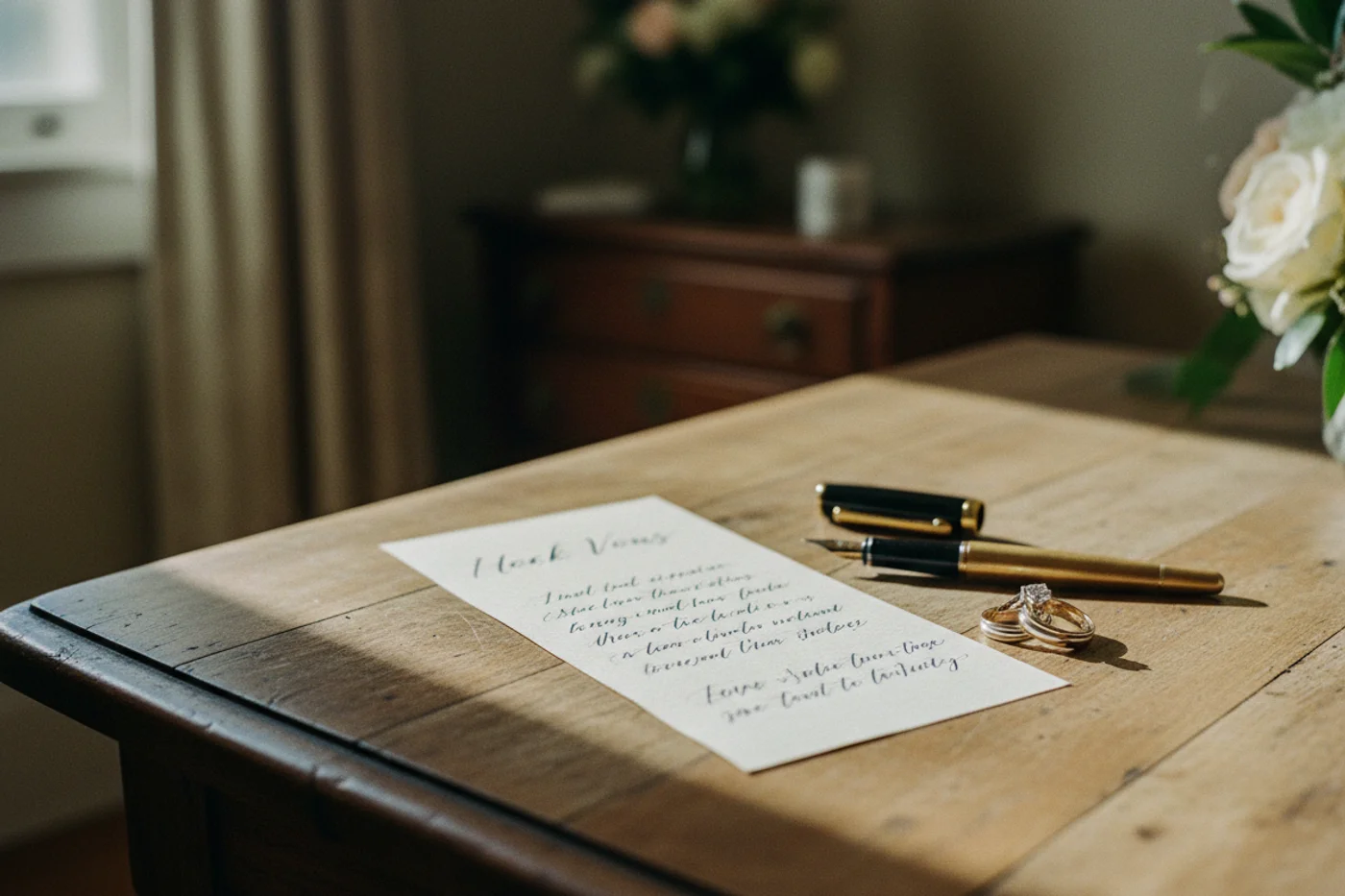
Four hundred years after his death, William Shakespeare is still the writer most people reach for when they want to say something about love and mean it. Across 38 plays and 154 sonnets, he wrote about love in every form it takes: reckless, patient, funny, doomed, steady. That range is exactly why his words still turn up in wedding ceremonies today, quoted by couples who've never read a full play in their lives. A well-chosen line from Shakespeare carries centuries of weight without sounding borrowed, because in a real sense, every love story since has borrowed from him first.
This is a curated set of Shakespeare's most quotable lines on love, organised by where they actually work best in a modern South African wedding: in your vows, as a reading during the ceremony, printed on your program or invitation, or dropped into a speech. Use them as a starting point, not a script — the best weddings adapt a quote to fit their own voice rather than reciting it word for word.
For Your Vows
Vows need to sound like you, so the trick with Shakespeare here is to borrow a phrase rather than the whole passage, then build your own words around it.
"Love is not love which alters when it alteration finds, or bends with the remover to remove." From Sonnet 116
This is the single most quoted wedding line from Shakespeare, and for good reason. Sonnet 116 argues that real love doesn't change when circumstances change — it's a definition, not a declaration, which makes it perfect groundwork for your own promise. You might open your vows with a version of this line, then follow it with your own commitment to what that steadiness looks like in practice.
"My bounty is as boundless as the sea, my love as deep; the more I give to thee, the more I have, for both are infinite." From his play, Romeo and Juliet
Juliet's words to Romeo capture something true about love that couples rediscover for themselves: it doesn't run out the more you spend it. This works beautifully near the end of a vow, right before you exchange rings.
"Doubt thou the stars are fire, doubt that the sun doth move, doubt truth to be a liar, but never doubt I love." From his play, Hamlet
Written as a love letter within the play, this line works as a vow because of its structure — everything else in the world might be uncertain, but this one thing isn't. Couples who want their vows to feel a little more dramatic and a little less conversational often gravitate to this one.
For a Ceremony Reading
If you want someone in your bridal party to do a reading during the ceremony, longer Shakespeare passages work better than single lines, since they give the reading some shape and build.
"Shall I compare thee to a summer's day? Thou art more lovely and more temperate." From Sonnet 18
Read in full, Sonnet 18 is fourteen lines about love outlasting time itself, which makes it a natural fit for a reading rather than a single quoted line. It's also the most recognisable of all his sonnets, which means guests will lean in the moment they recognise the opening line.
"Love comforteth like sunshine after rain." From his poem, Venus and Adonis
A shorter, gentler option if you want something warm rather than grand. This line works well early in a reading, paired with a second, longer quote to round it out.
"They do not love that do not show their love." From his play, Two Gentlemen of Verona
A simple, almost blunt line about love needing to be visible, not just felt. It reads well as a closing line for a reading, especially one focused on the idea of choosing your partner actively, every day, rather than passively.
For Your Program, Invitation, or Table Cards
Shorter lines work best in print, where there's limited space and the words need to land quickly.
"Love looks not with the eyes, but with the mind." From his play, A Midsummer Night's Dream
Elegant, brief, and instantly recognisable even out of context — a good choice for the cover of a program or the header of your invitation.
"The course of true love never did run smooth." From his play, A Midsummer Night's Dream
A little wry, a little knowing — this suits couples who want their stationery to have some personality rather than pure romance. It also works nicely if your relationship had its own bumps along the way to the altar.
"Journeys end in lovers meeting." From his play, Twelfth Night
If your love story involved distance, long-distance dating, or simply a long road to this particular day, this line does a lot of work in six words.
For Toasts and Speeches
Best men, maids of honour, and parents giving speeches often want something with a bit more wit than pure sentiment, and Shakespeare has that too.
"If music be the food of love, play on…" From his play, Twelfth Night
A natural line to use if there's live music at the reception, or simply as an opener before raising a glass.
"Love sought is good, but given unsought, is better." From his play, Twelfth Night
Useful in a speech that touches on how the couple got together, particularly if one of them wasn't looking for a relationship when they met the other.
"Now join your hands, and with your hands your hearts." From his play, King Henry IV
Short, formal, and perfectly timed for the moment right before a couple exchanges rings — a celebrant or officiant can use this as a lead-in line even if the rest of the ceremony isn't literary at all.
Choosing the Right Play for the Right Mood
Shakespeare's love writing spans comedies, tragedies, and sonnets, and each source carries a slightly different tone worth knowing before you pick a line. A Midsummer Night's Dream and Twelfth Night are comedies, so their love lines tend to be lighter, wiser, sometimes a little teasing about how illogical love can be. Romeo and Juliet, despite its tragic ending, contains some of his most passionate and unguarded lines about love, which makes it a rich source for vows even though the play itself ends badly — nobody quoting Juliet at their wedding is implying anything about the ending. The sonnets stand apart from the plays entirely: written in first person, with no characters or plot to filter through, they read as Shakespeare's most direct statements about love, which is exactly why Sonnets 18 and 116 dominate wedding readings above almost everything else he wrote.
Matching a Quote to How You Actually Met
The strongest use of a Shakespeare quote at a wedding isn't the most famous line, it's the one that fits the specific story of the couple saying it. If your relationship started slowly, built on friendship before anything romantic developed, "They do not love that do not show their love" from Two Gentlemen of Verona carries more weight than a grander line, because it speaks directly to a love that had to be recognised and acted on rather than one that arrived instantly. If you had a rocky start, missed timing, or one of you took convincing, "The course of true love never did run smooth" acknowledges that history with a wink rather than pretending it didn't happen. And if your story involved distance, whether that was a long-distance relationship, working in different cities, or simply years apart before reconnecting, "Journeys end in lovers meeting" does something a generic love quote can't: it tells your specific story in six words.
This is worth spending real time on before the wedding, ideally together. Read through a handful of these quotes as a couple and talk about which ones feel like they're describing your relationship rather than love in the abstract. The quote you land on this way will mean more to you on the day, and it usually means more to your guests too, because a well-matched line often prompts a knowing look between people who know your story.
A Few Ground Rules for Quoting Shakespeare at Your Wedding
Keep the language as close to the original as you can — Shakespeare's rhythm is part of what makes these lines work, and paraphrasing tends to flatten it. If the original phrasing feels too archaic for your ceremony's tone, choose a different quote rather than rewriting his words; there are dozens of options across the plays and sonnets to fit almost any register. Always credit the source, even briefly, since "Shakespeare" alone tells your guests less than "from Sonnet 116" or "from Twelfth Night." And resist the urge to cram in more than two or three quotes across an entire ceremony — a handful of well-placed lines land far harder than a dozen scattered through every part of the day.
Whichever lines you choose, the reason they still work centuries later is simple: Shakespeare wrote about love with total conviction, without irony or hedging, at a time when very few writers dared to. That's a tone worth borrowing on the one day when total conviction is exactly what you're there to declare.
Working a Quote Into a Ceremony That Isn't Otherwise Literary
You don't need a full literary theme to use Shakespeare well. Plenty of relaxed, modern South African ceremonies drop in a single line without making the rest of the day feel like an English literature seminar. A celebrant can introduce a line simply, saying something like "there's a phrase from Shakespeare that captures what I want to say here" before reading it, which frames it as a tool for expressing something true rather than a display of literary knowledge. Couples writing their own vows can do the same by opening with a borrowed line and then immediately following it with their own words, so the quote becomes a springboard rather than a substitute for saying something personal. The goal isn't to sound like an actor performing Shakespeare — it's to borrow language precise enough to say what you actually mean, then build the rest of the moment in your own voice.

Traditional & Religious Wedding Vows: Full Wording by Faith and Tradition
Shakespeare Poems Part III: Wedding Sonnets Beyond the Greatest Hits
Romantic Poems Part III: Short Poems for Wedding Readings

The Most Famous Love Poems for Your Wedding

Meet Dr Heinrich Lottering: Pretoria's Marriage Officer With a Medical Degree and Two PhDs