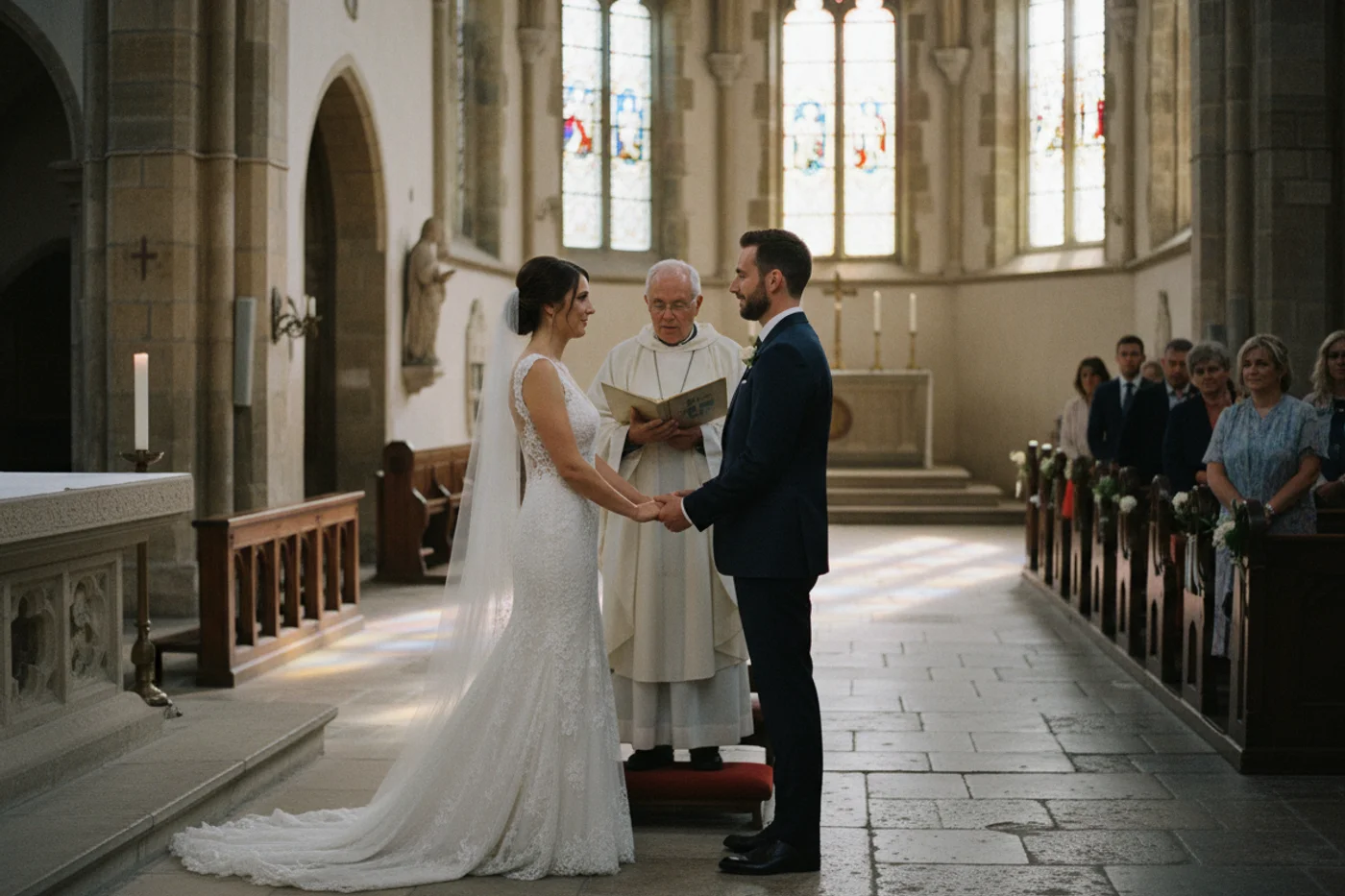
Ask anyone what a Sesotho wedding dress looks like and they will describe the same thing. Deep indigo shweshwe with a fine white print, a full skirt that holds its shape, and often a Basotho blanket pinned over the shoulders for good measure. That outfit is the most visible part of a Sotho or Tswana traditional wedding, but it sits on top of something much older, a set of negotiations, visits and welcomes that join two families long before anyone gets dressed up.
Basotho and Batswana are distinct peoples with their own languages, histories and customs, and this guide gives each its own section. They also share a great deal, from the bride wealth (bohadi in Sesotho, bogadi in Setswana) to the uncles and aunts who run the show. Both are woven into the story of South African traditional weddings, from the Free State and Gauteng to the North West, with deep family ties across the borders with Lesotho and Botswana.
One honest caveat before we start. Every family does this its own way. A family in Maseru, one in QwaQwa and one in Soweto may use different names for the same step or skip it altogether. Use what follows as a well-informed starting point for conversations with your elders, not a rulebook.
Sotho and Tswana: related, not the same
Sesotho (sometimes called Southern Sotho) and Setswana both belong to the Sotho-Tswana language group, alongside Sepedi. The words sound alike, and the customs often run in parallel. You will hear that in the bride wealth itself. The Dictionary of South African English notes that bogadi (Setswana and Northern Sotho), bohadi (South African Sesotho) and bohali (the spelling used in Lesotho) are pronounced the same way and mean the same thing, the cattle given to fulfil a marriage contract.
Where the two peoples live matters too. Most Basotho in South Africa have roots in the Free State, Gauteng and the eastern Free State's border with Lesotho. Batswana are concentrated in the North West, around Mahikeng, Rustenburg and the Bafokeng area, with a historic community at Thaba Nchu in the Free State and close family links to Botswana. That's why a Free State wedding can easily be a Sotho-Tswana wedding, with both sets of customs in the room.
A traditional Basotho wedding, step by step
The order below is common, but families combine, rename and reorder stages all the time.
The approach and the delegation
The couple tells their families, and the groom's side sends word that they want to talk. Negotiations are not run by the couple. The groom's family sends a small delegation, usually led by the malome (the maternal uncle) and older relatives, and the bride's family fields its own. Researcher D.K. Semenya, writing in HTS Teologiese Studies, describes these talks as formal, conducted in writing, and sometimes lasting days.
Bohadi negotiations
Bohadi was traditionally counted in cattle. Today most families agree a cash value per cow and pay part or all of it in money, but the amount is still spoken of as cattle. The figure depends on the family, the region and sometimes the bride's circumstances, and it is rarely paid in one go. Gifts usually travel with the payment. Blankets are the classic Sotho choice, along with items for the bride's parents. Our full lobola guide for South Africa covers the letters, etiquette and realistic figures, so we won't repeat them here.
Celebration at the bride's home
Once bohadi is agreed, the families celebrate. In many families an animal is slaughtered to mark the agreement. Expect singing, ululation and a crowd that grows as the afternoon goes on.
Welcoming the ngwetsi
The bride then joins her husband's family as their ngwetsi, the Sesotho word for daughter-in-law. In one family's practice reported by the Sunday Times, the groom's Sesotho family welcomed the bride with the slaughter of a sheep and fed her the sefuba, a cut from the chest. The older women told her it meant that what happens in the family home stays in the family.
The welcome is also where the counsel happens. The bride's aunts and the women of her new family take her aside to talk about marriage, respect for her in-laws and how to carry herself in their home. The groom gets his own talking-to from the uncles.
A new name
Many Basotho families give the bride a new name when she arrives, so that her in-laws no longer use her maiden name. Semenya notes that Southern Sotho families typically name the bride at her arrival, and that the name is often echoed later in her first child's name. In Lesotho, customary law has traditionally given the mother-in-law the right to choose it, and the familiar 'Ma- form (as in 'Mathabo, "mother of Thabo") usually follows once the first child is born.
A traditional Tswana wedding, step by step
Batswana weddings have their own vocabulary, and the stages are well documented in Botswana scholarship. South African Batswana families in the North West follow broadly the same shape, with plenty of local variation.
Patlo, asking for the bride
Patlo is the formal asking for the bride's hand. The groom's family visits the bride's home, traditionally early in the morning, to ask for her. Talks run through go-betweens, a married man and a married woman known as raditsela and mmaditsela. Botswana's Daily News notes that unmarried adults were traditionally kept out of the room.
Bogadi
Bogadi follows, and its meaning carries weight. North-West University explains that it expresses a pledge and gratitude to the bride's family, not a sale, and that uncles and aunts lead the proceedings. The number of cattle varied by region and clan. Among the Batlokwa in Madikwe, two cattle, a bull and a cow, were offered to represent the couple.
Not everyone agrees on bogadi's place. In Botswana, KgosiKwena Sebele, the former Bakwena regent, has argued publicly that bogadi is not part of Setswana culture at all, and that patlo is what makes a marriage. It's one traditionalist's view, but a reminder that even within one culture there is real debate.
Go laya, counsel for the couple
Before the bride leaves home, the elders counsel her in go laya. Women sing songs about marriage and the bride's readiness, and the advice is frank. In many families the groom is counselled too. If you're a guest, this is a moment to listen, not film.
Go isiwa ga ngwetsi
The final stage is go isiwa ga ngwetsi, escorting the bride (ngwetsi in Setswana as well) to her in-laws' home. A University of Botswana study describes it as the moment that introduces the bride to her husband's family and lets her take part in family life with ease. There is a moletlo, a celebration, with food and singing at both homes.
Food at a Tswana wedding
The signature dish is seswaa, beef or goat boiled for hours in three-legged pots with little more than salt and water, then pounded until it falls apart. Men traditionally cook it. Alongside you'll find dikgobe (samp cooked with beans) and, especially in Botswana, bogobe jwa lerotse, sorghum porridge cooked with melon. It smells of wood smoke and tastes of patience.
What Sotho and Tswana weddings share
- Bride wealth that joins families. Bohadi and bogadi both bind two families, not just two people, and both are now usually paid at least partly in cash.
- Uncles and aunts in charge. The malome and the rakgadi (the paternal aunt) carry the negotiations, the counsel and much of the ceremony.
- A bride who becomes ngwetsi. Both welcome the bride into her husband's family as daughter-in-law, with advice from the women and often a new name.
- Slaughter and feasting. An animal marks the agreement and the welcome, and the meat is shared out with care.
- Shweshwe. The same printed cotton dresses both brides, which is why Sotho and Tswana wedding outfits can look so alike.
For how these compare with other cultures, see our hub on traditional weddings in South Africa, our step-by-step traditional Zulu wedding guide, the traditional Xhosa wedding and the Tsonga traditional wedding.
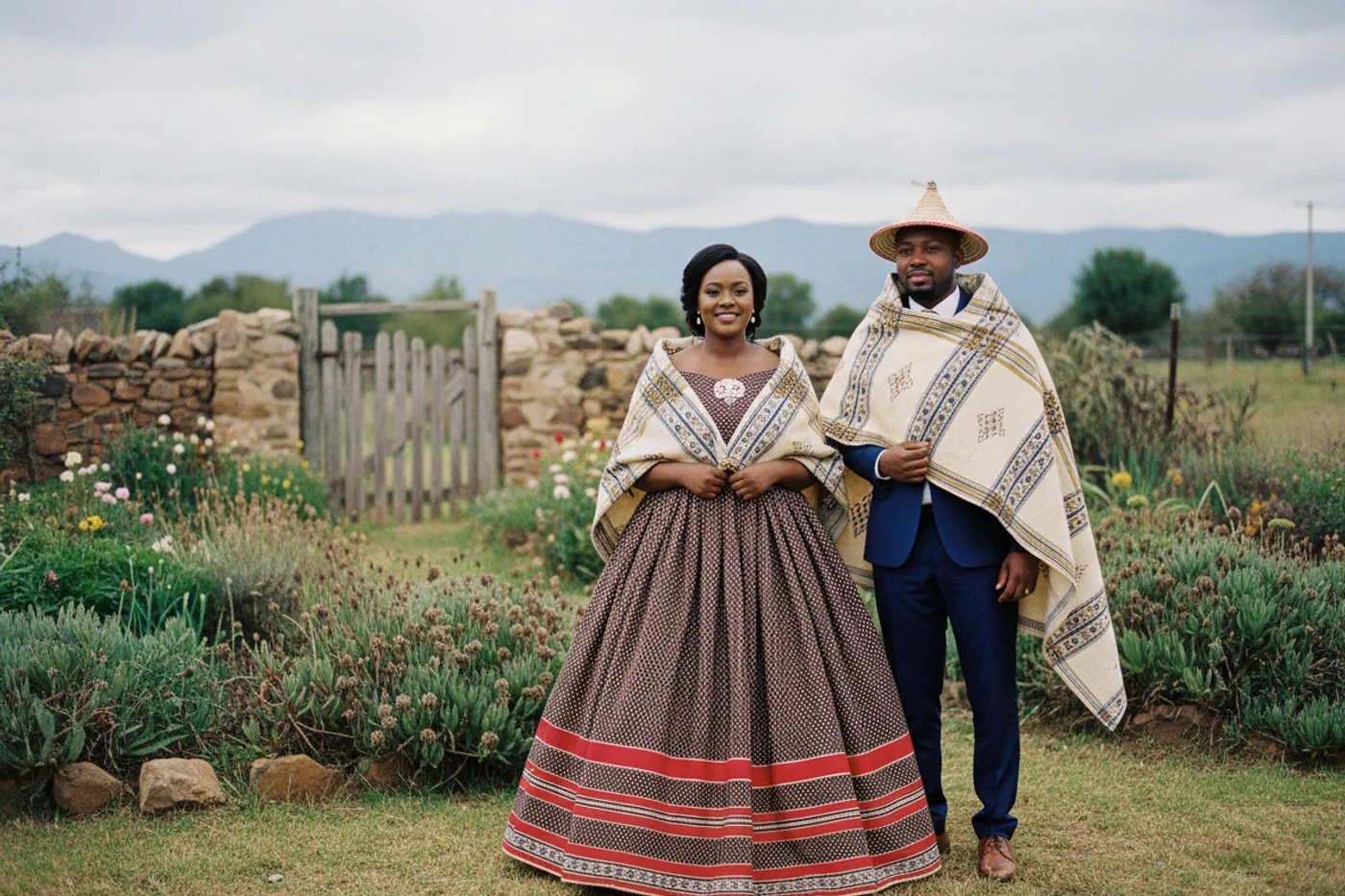
Sesotho wedding dress and Basotho attire
This is the part most couples spend months planning. For the full picture across cultures, see our guide to traditional wedding attire in South Africa.
Shweshwe, the fabric behind it all
Shweshwe (seshweshwe in South African Sesotho, seshoeshoe in Lesotho) is a printed cotton with tiny, intricate geometric patterns. It started out indigo with a white print, and today comes in blue, chocolate brown, red and many more colours. Its local name is widely linked to King Moshoeshoe I, who is said to have been given indigo cloth by French missionaries in the 1840s and helped make it popular. German and Swiss settlers brought blaudruck ("blue print") too, which is why older Sesotho speakers also call it sejeremane.
The best-known brand is Three Cats. It was made by Spruce Manufacturing in Manchester until 1992, when Da Gama Textiles bought the sole rights and shipped the original engraved copper rollers to its factory at Zwelitsha, near Qonce (King William's Town) in the Eastern Cape. Da Gama had been printing shweshwe there since 1982 and still does. The white pattern is created by discharge printing, where a weak acid bleaches the design out of the dyed cloth. It's the reason genuine shweshwe has such crisp detail.
The Sesotho wedding dress
The classic shape is a fitted bodice with a full, often tiered skirt, sometimes finished with bands of contrasting shweshwe or ribbon. Modern Sesotho wedding dresses go much further, with off-the-shoulder necklines, mermaid skirts, long trains and structured capes. Many brides wear one outfit for the traditional ceremony and change for the reception. Married Basotho women have long worn shweshwe day to day, so a bride in it is also stepping into that line.
The Basotho blanket
No Sotho wedding is complete without blankets. They were adopted in the 19th century as sheepskin karosses grew scarce, and King Moshoeshoe I helped establish them. Each design has a name and a meaning. Seanamarena is the chief's blanket, historically the highest in status of them all. The bride's blanket is the Lingoetsi, which replaced the older Motlotlehi. Aranda, the Randfontein mill that makes the heritage designs, describes a ceremony in which the bride is wrapped in blankets and handed to the groom, who unwraps her.
How you wear it matters. Men wear the blanket over the right shoulder with the right arm free, while women pin it at the centre of the chest. The pinstripes run vertically, which Basotho read as growing up. Blankets are also given to the couple and their families as gifts.
The mokorotlo
The mokorotlo is the conical woven-grass hat that appears on Lesotho's flag. Its shape is said to come from Qiloane, the cone-shaped hill near Thaba Bosiu. It is a newer tradition than many people assume, with historians tracing it to the early 20th century, but it's now a proud symbol of Basotho identity, and a natural partner for a blanket and shweshwe on a wedding day.
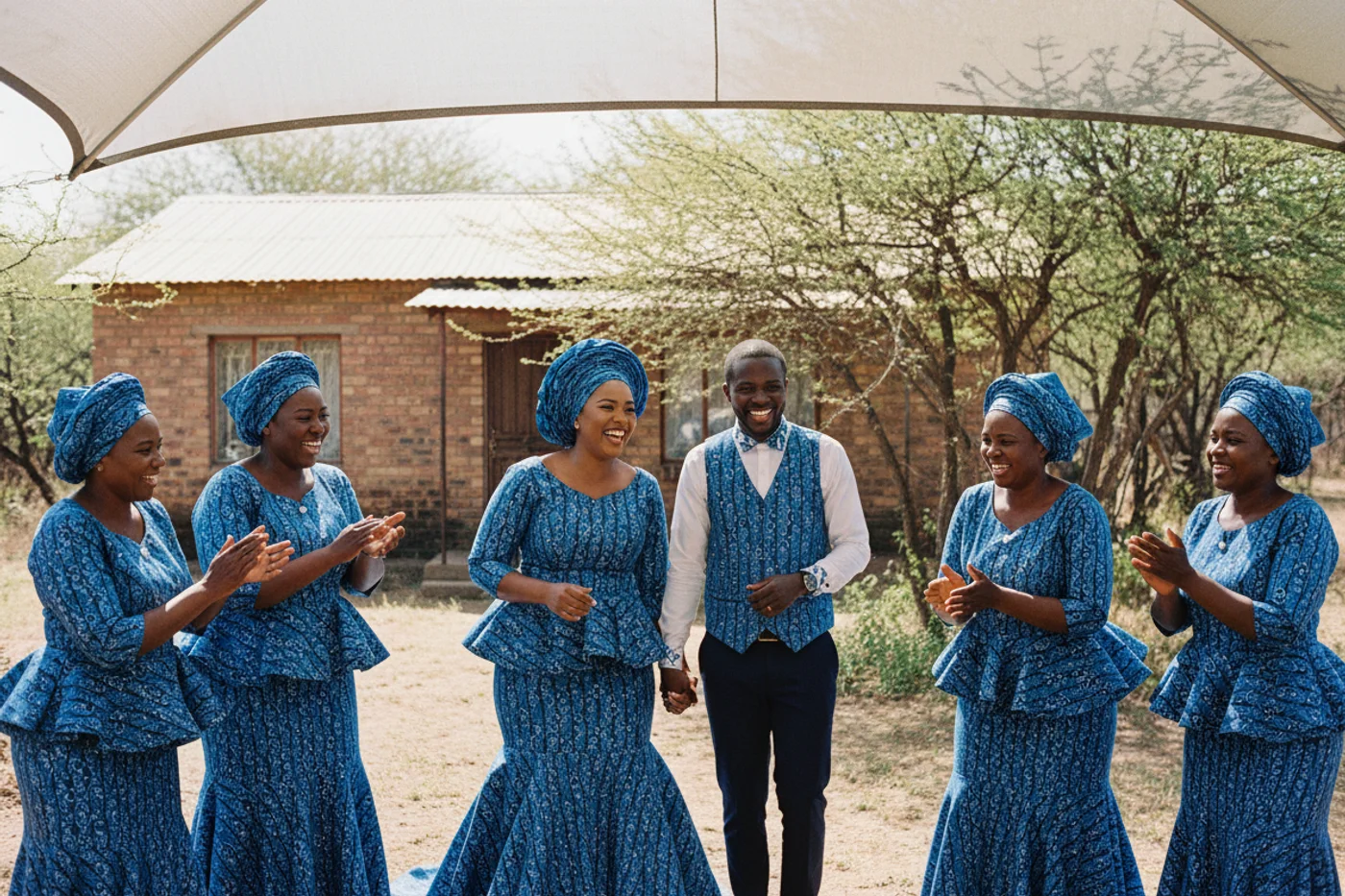
Tswana traditional wedding attire
Batswana brides wear shweshwe too, most often in blue. In Botswana the fabric is known as leteisi (also spelled letoitse), first associated with the Bakgatla and Bakwena and now worn across the country at weddings, patlo and other formal occasions. In South Africa it's usually just called shweshwe.
A Tswana bride might wear a fitted shweshwe gown with a matching headwrap, with her groom in a shweshwe shirt, waistcoat or jacket over dark trousers. Bridesmaids and family members often wear the same print in a coordinated colour so the whole party reads as one. Designers in Botswana have also pushed leteisi into menswear and blended it with silk.
If one family is Sotho and the other Tswana, you'll often see both brides' sides in shweshwe and the Sotho family in blankets. It looks wonderful in photographs.
Choosing or commissioning a shweshwe wedding dress
Pick your style first
- Traditional full skirt. Fitted bodice, gathered or tiered skirt, often with bands of trim. Comfortable for dancing and kneeling.
- Mermaid or fishtail. Fitted to the knee, flaring out. Dramatic for the reception, harder to sit and dance in.
- Two-piece. A crop top or corset with a full skirt, easy to restyle later.
- Combination. Shweshwe panels with plain satin or tulle, or a shweshwe cape over a white gown for couples blending both ceremonies.
How to spot real shweshwe
- Check the back. Genuine Da Gama shweshwe carries a trademark backstamp, such as Three Cats, and the reverse is a solid colour.
- Feel it. New cloth is stiff with starch and has a distinctive smell. The starch washes out and the fabric softens.
- Measure the width. It's narrower than most dress fabric, about 90 cm.
- Look at the print. Discharge-printed detail is crisp. Cheaper imitations, often polyester-cotton blends imported from Asia, tend to look flatter.
Timelines and budget
Book your designer early, ideally four to six months ahead, and longer if your ceremony falls in the December or Easter rush. Allow for two or three fittings. A full skirt eats fabric, so don't be surprised if your designer asks for 10 metres or more. Prices vary hugely between a neighbourhood dressmaker and a couture name, and most designers quote on enquiry once they have seen your sketch and measurements. Get the quote in writing, including fabric, and confirm whether matching pieces for the groom or bridesmaids are included.
For more on fit and shape, read which wedding dress style suits your body shape and how to choose your wedding dress. For the groom's side, see our guide to wedding menswear. If you're shopping in Joburg or Pretoria, our roundup of bridal boutiques in Gauteng is a good place to start.
Registration and the white wedding
Most Sotho and Tswana couples also hold a white wedding, sometimes on the same weekend and sometimes years later. Either way, register your customary marriage with Home Affairs, and check how it interacts with any civil marriage before you book. Our guide to customary marriage in South Africa explains the requirements and what they mean for property.
For the celebration itself, Free State couples can browse wedding venues in the Free State or our pick of the top wedding venues in the Free State, and North West couples the North West wedding venues and our roundup of top wedding venues in North West. Choose a photographer who has shot traditional ceremonies before, such as those in our lists of Free State wedding photographers and North West wedding photographers.
Practical tips for planning
- Ask both families early. Find out which stages each family practises and what they call them. Write it down.
- Order blankets in good time. If you're gifting heritage designs, check stock well before peak season.
- Plan for the homestead. Discuss fire space, tents, chairs and water if ceremonies are at a family home, and whether a caterer will work alongside the family cooks.
- Coordinate prints. Agree the shweshwe colour and pattern for the bridal party before anyone buys fabric. Dye lots differ.
- Respect the private moments. Counsel and some rituals are not for cameras. Ask the elders what may be photographed.
Frequently asked questions
What is a Sesotho wedding dress made of?
It's traditionally made from shweshwe (seshweshwe), a printed cotton with fine geometric patterns, most often in indigo, brown or red. Many brides pair it with a Basotho blanket.
What is the difference between bohadi and bogadi?
They are the same thing, bride wealth paid to the bride's family. Bohadi is the South African Sesotho spelling, bohali is used in Lesotho and bogadi is the Setswana spelling.
What happens at a Tswana traditional wedding?
The groom's family formally asks for the bride at patlo, bogadi is agreed, and the elders counsel the couple in go laya. The bride is then escorted to her in-laws' home in go isiwa ga ngwetsi, with a celebration at both homes.
How can I tell if shweshwe is real?
Genuine shweshwe has a trademark backstamp such as Three Cats, a solid-coloured reverse, a width of about 90 cm and a stiff, starchy feel when new. Imitations are often softer, flatter and made with polyester.
Which Basotho blanket is worn at a wedding?
The Lingoetsi is known as the bride's blanket, and blankets are also given to the couple and their families as gifts. Families choose their own designs, so ask your elders.
Do Sotho brides get a new name?
Many do. The groom's family names her when she arrives so they don't use her maiden name, and in Lesotho the mother-in-law traditionally chooses it.
Find vendors for your Sotho or Tswana wedding
The Wedding Directory lists South African photographers, caterers and décor and hire specialists who understand traditional ceremonies. Browse the full wedding vendor directory by region and enquire directly.
Tsonga Traditional Wedding: Customs, Attire and Ceremonies
Traditional Zulu Wedding: From Lobola to Umabo, Step by Step
Traditional Xhosa Wedding: Customs, Attire and Ceremonies
Shakespeare Quotes